
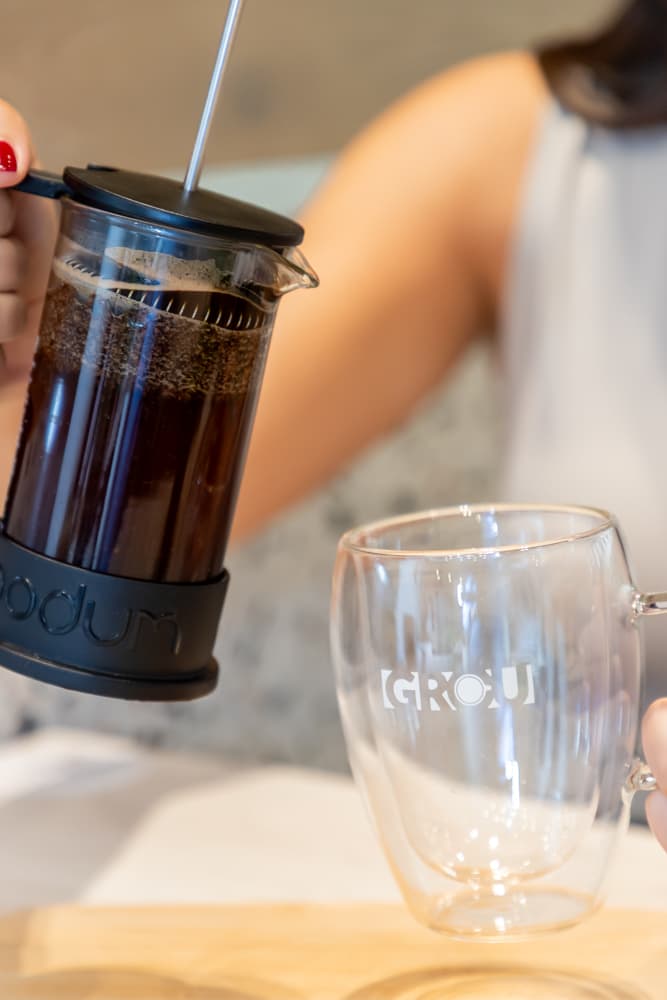
French Press vs Pour Over: Which Brewing Method Is Right for You?
Compare French press and pour-over by flavor, texture, grind, equipment and cleanup, then choose the method that fits your coffee routine.
French press and pour-over can begin with the same two ingredients and produce noticeably different cups. One immerses coffee in water and uses a metal screen; the other sends water through a bed of coffee and, usually, a paper filter. That structural difference affects texture, clarity, technique and cleanup.
Neither method is universally better. The right choice depends on what you like to taste and how involved you want to be in the brewing process.
The main difference
French press is an immersion method. Coffee and water stay together for most of the brew, then the plunger separates the grounds from the drink. A metal mesh lets oils and very fine particles remain in the cup.
Pour-over is a percolation method. Fresh water moves through the coffee bed and filter as you pour. Paper traps more oils and fine particles, producing a cleaner-looking and lighter-textured cup.
Flavor and texture
French press
Expect a rounder body, more texture and a cup that can feel rich or dense. Because the mesh is not as fine as paper, a small amount of sediment is normal. Medium and darker profiles can feel especially comforting, but a well-prepared light roast can also be expressive.
Pour-over
Expect more clarity and separation between flavors. Floral, fruit and citrus notes may be easier to identify, and the finish often feels cleaner. Pour-over can expose inconsistencies, so grind size and pouring technique are more noticeable.
Equipment and attention
French press: press, scale, timer, grinder and kettle. A standard kettle works well.
Pour-over: dripper, paper filters, scale, timer, grinder and kettle. A gooseneck kettle helps control flow but is not mandatory for learning.
French press asks for less active pouring: combine the ingredients, wait, then plunge gently. Pour-over asks you to manage how fast and where the water enters throughout the brew. Some people enjoy that ritual; others prefer a method that lets them step away.
Starting recipes
French press recipe
Use 30 g of coffee and 450 g of water, a 1:15 ratio.
Choose a medium-coarse to coarse grind.
Saturate all grounds, stir gently if needed and place the lid on top.
Steep for about four minutes, then plunge slowly without forcing it.
Pour the full brew out of the press so extraction does not continue.
Pour-over recipe
Use 20 g of coffee and 320 g of water, a 1:16 ratio.
Choose a medium grind as a starting point.
Rinse the paper filter and discard the rinse water.
Add enough water to wet all the grounds and allow a short bloom.
Continue in controlled pours, keeping the coffee bed evenly saturated.
Brewers vary in shape and flow, so treat time as feedback rather than a universal target. The coffee-to-water ratio guide explains how to adjust strength without confusing it with extraction.
Which method is more forgiving?
French press is generally more forgiving of pouring technique because all the coffee steeps together. It still needs a sensible grind and time: too fine can create sludge and bitterness, while too coarse or too brief can leave the cup weak.
Pour-over rewards control. Uneven pouring, dry pockets or channeling can make one part of the coffee extract more than another. Once the motion becomes familiar, that control is also its advantage.
Which is easier to clean?
Pour-over cleanup is usually quick: lift the paper filter with the grounds, compost or discard it, and rinse the dripper. With French press, grounds collect beneath the screen and should be removed before washing. Avoid sending a dense mass of grounds down the sink.
If you compost at home, read our guide on using coffee grounds for plants before adding large amounts directly to soil.
How roast level changes the result
A light roast can show high clarity in pour-over and gain extra body in a French press. A dark roast can feel bold in a press and cleaner through paper. Use our guide to light vs dark roast to understand the flavor tradeoffs, then make the method serve the coffee, not the label.
Choose French press if…
You enjoy body, oils and a substantial texture.
You want to brew several cups with limited active pouring.
You prefer reusable metal filtration.
A little sediment does not bother you.
Choose pour-over if…
You enjoy a clean finish and clearly separated flavors.
You like the hands-on ritual of controlling the pour.
You often explore lighter, aromatic coffees.
You value fast, contained cleanup.
Still unsure? Order a filter coffee or ask the team about current beans on the GROU menu. You can also find coffee for home in the GROU shop. The best method is the one you will use consistently, and the one that makes you want another cup.
Frequently asked questions
- What is the difference between French press and pour over coffee?
- French press is an immersion method and pour over is a percolation method. In a French press the coffee and water stay together for most of the brew, then a plunger with a metal mesh separates the grounds, so oils and very fine particles remain in the cup. With pour over, fresh water moves through the coffee bed and a paper filter as you pour, and the paper traps more oils and fines, giving a cleaner-looking, lighter-textured cup.
- Which tastes better, French press or pour over?
- Neither one is universally better. It depends on the texture and flavors you enjoy. French press gives a rounder body, more texture and a cup that can feel rich or dense, with a small amount of sediment that is completely normal. Pour over gives more clarity and separation between flavors, so floral, fruit and citrus notes are often easier to identify and the finish tends to feel cleaner.
- How much coffee and what grind size do I use for French press and pour over?
- For French press, use 30 g of coffee and 450 g of water, a 1:15 ratio, with a medium-coarse to coarse grind, steeping about four minutes before plunging slowly. For pour over, use 20 g of coffee and 320 g of water, a 1:16 ratio, with a medium grind as a starting point. Rinse the paper filter first, wet all the grounds for a short bloom, then continue in controlled pours.
- Which method is easier if you are just starting out?
- French press is generally more forgiving, because all the coffee steeps together and pouring technique matters less. It still needs a sensible grind and time: too fine can create sludge and bitterness, while too coarse or too brief leaves the cup weak. Pour over rewards control and can expose inconsistencies such as uneven pouring, dry pockets or channeling, though once the motion becomes familiar that control turns into its main advantage.
- Which is easier to clean, a French press or a pour over dripper?
- Pour over is usually quicker to clean. You lift the paper filter with the grounds, compost or discard it, and rinse the dripper. A French press collects grounds beneath the metal screen, and they should be removed before washing. Avoid sending a dense mass of wet grounds down the sink, and if you compost at home, check how coffee grounds should be used on plants before adding large amounts directly to soil.
- Where can I try specialty coffee in Coral Gables?
- GROU Coffee + Cowork is a specialty coffee shop, all-day brunch kitchen and coworking space at 4100 Salzedo St STE 5, Coral Gables, FL 33146, rated 4.8 from more than 1,000 Google reviews. The menu includes Coffee, Espresso, Cortado, Flat White, Cold Brew and Matcha Latte, and the team can point you to something to try. Hours are Monday to Friday 7:30 AM to 6 PM and Saturday and Sunday 8:30 AM to 3 PM. Phone: +1 (305) 639-8218.
Visit us
GROU Coffee + Cowork
- Mon-Fri 7:30 AM - 6 PM Sat-Sun 8:30 AM - 3 PM
- 2 hours free parking Walk in, no reservations
Keep reading
How to Know If Your Coffee Is Expired (And Why Roast Date Matters More)
Discover how to know if your coffee is expired and why the roast date matters more than the expiration date for freshness and flavor.
What Is a Cortadito? Miami's Coffee, Explained
A cortadito is Cuban espresso cut with steamed milk and sweetened as it brews. The sugar is the part everyone gets wrong.
What Is a Chagaccino? The Chaga Coffee Drink, Explained
A chagaccino is a cappuccino made with chaga, a fungus that grows on birch trees, blended with cocoa and cinnamon. Here is what it tastes like, how much caffeine it has, and what nobody can honestly claim about it.