
What Are Tequeños? The Venezuelan Cheese Stick Miami Eats for Breakfast
A tequeño is a strip of wheat dough wrapped around salty white cheese and fried. Where the Venezuelan classic comes from, what cheese belongs inside, and why Miami eats it in the morning.
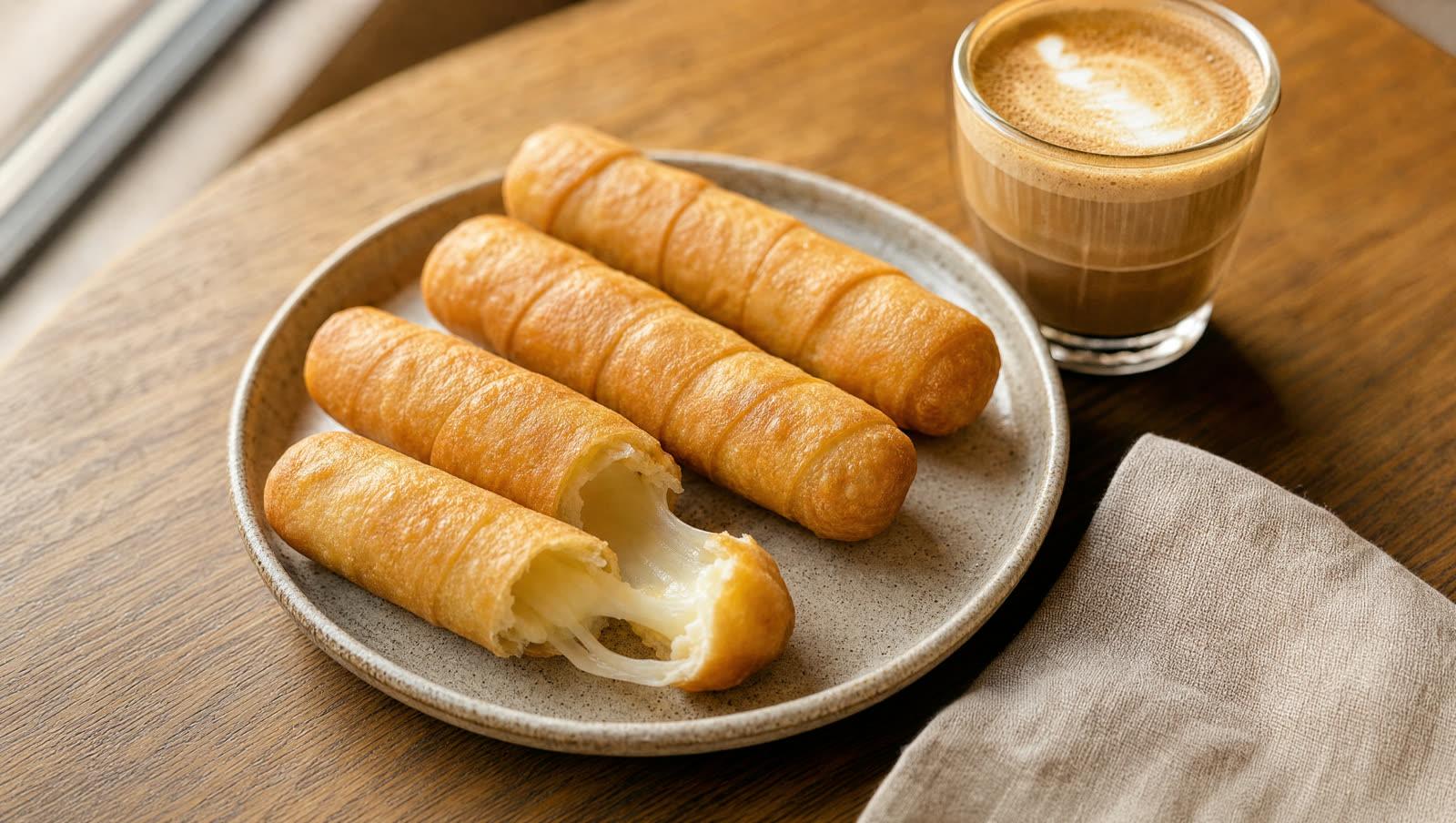
A tequeño is a strip of soft wheat dough wrapped in a spiral around a stick of firm, salty white cheese and fried until the outside turns golden and the inside goes molten. It is Venezuelan, it is about the length of a finger, it is savory rather than sweet, and it is eaten with your hands. That is the entire concept, and it has traveled from birthday parties in Caracas to pastry cases in Miami without changing much at all.
If you moved to South Florida and kept noticing a golden spiral sitting on every counter, next to the croissants and the empanadas, that is a tequeño. Here is what is inside it, where it came from, and why so many people here eat it at eight in the morning.
What exactly is a tequeño?
Three components, no more.
- The dough. A simple wheat dough, closer to bread than to puff pastry. Flour, water or milk, a little fat, often an egg, sometimes a pinch of sugar. It gets rolled thin and cut into long ribbons.
- The cheese. A firm white cheese cut into batons. It has to be salty and it has to hold its shape when it gets hot.
- The wrap. The ribbon of dough is wound around the cheese at an angle, each turn overlapping the last, with the ends pinched shut so nothing leaks out.
Then it goes into hot oil. What comes out has three textures in one bite: a crisp golden shell, a soft chewy layer of bread underneath it, and a salty molten center. That contrast is the reason the tequeño survived generations of Venezuelan parties and a migration across the Caribbean.
Size matters more than people expect. A tequeño is deliberately small. It is finger food, built to be picked off a tray, eaten in two bites, and followed immediately by another one.
Where do tequeños come from?
Venezuela. The name almost certainly points to Los Teques, the capital of Miranda state, near Caracas, whose residents are called tequeños.
The origin story you will hear repeated at family tables goes like this: sometime around the turn of the twentieth century, a cook at a hacienda near Los Teques had leftover dough and leftover cheese, wrapped one around the other, fried it, and served it to guests who never forgot it. Some versions name a family, some name a specific house. It is a good story and it may well be true, but it is folklore rather than documented history, so it deserves to be told with that caveat attached.
What is not in question is the role the tequeño plays. In Venezuela it is party food in the most literal sense: birthdays, weddings, graduations, baptisms, New Year's Eve. There is a saying that a party without tequeños is not really a party, and anyone who grew up there will tell you the tray never makes it back to the kitchen full.
What kind of cheese goes inside a tequeño?
Traditionally, a firm salty white cheese: queso blanco duro, or queso llanero, the aged, salt-cured cheese from the Venezuelan plains. The qualities that matter are salinity and structure. The cheese should soften into a creamy, stretchy center without turning to liquid and running out the ends.
Outside Venezuela, cooks work with what the local market carries. Queso blanco, queso de freír and low-moisture mozzarella all show up, sometimes blended, because each one solves half the problem. Mozzarella melts beautifully but is mild, so on its own it can taste flat inside all that dough. A saltier, firmer cheese brings the seasoning but resists melting. Getting both at once is the whole craft of a good tequeño.
It is also why a tequeño made with the wrong cheese is obvious to anyone who grew up eating them. The shape can be perfect and the bite can still be wrong.
Are tequeños just Venezuelan mozzarella sticks?
No, and the difference is not a technicality. A mozzarella stick is cheese coated in breadcrumbs. A tequeño is cheese wrapped in dough. That single distinction changes everything downstream.
Because the coating is bread dough, a tequeño has real structure. You bite through a crisp exterior, then a genuine layer of soft bread, and only then reach the cheese. A mozzarella stick goes straight from crunch to stretch, with nothing in between. The tequeño also shows a visible spiral seam, which is how you spot a handmade one, and the cheese inside is usually saltier and firmer than the mild mozzarella in an American appetizer.
The other difference is timing. Mozzarella sticks are a bar snack that appears after dark. Tequeños get eaten at any hour of the day, which is what brings us to Miami.
Why do people in Miami eat tequeños for breakfast?
Because the morning pastry case in Miami is Latin American, and across Latin America a savory cheese bread is a completely normal way to start the day.
South Florida is home to a large Venezuelan community, and food moves with people. But the tequeño never had to fight for its spot at breakfast here, because the format was already familiar. Colombians have pan de bono. Brazilians have pão de queijo. Venezuelans and Colombians both have arepas, and empanadas exist nearly everywhere on the continent. The template repeats: something warm and handheld, made of starch and cheese, eaten next to a small, strong coffee.
There are practical reasons too, and in a city that eats in the car they matter more than people admit.
- No cutlery. A tequeño needs one hand. You can eat it standing at a counter or between two calls.
- It travels. It survives a bag on the way to an office better than anything with runny yolk in it.
- It is salty. A morning pastry case is usually a wall of sugar, and something savory is a relief.
- It goes with coffee. Salt and fat against espresso is a pairing the whole region settled on a long time ago.
The coffee pairing is worth thinking about. A tequeño is rich, so it plays best against something with acidity or bite. A cortado gives you enough milk to round the edge without burying it. A cold brew cuts straight through it. A Cuban Colada is the maximal version of the same instinct: tiny, sweet, intense and completely at home next to fried cheese.
What do you dip tequeños in?
In Venezuela the default is salsa rosada, the ketchup and mayonnaise mix that appears beside almost everything fried. Guasacaca, the avocado and herb sauce, is the other classic, and garlic sauces are common as well.
Sweet dips are common too. Guava paste loosened into a sauce, condensed milk and nata all turn up next to tequeños, and the sweet and salty combination lands better than it sounds to anyone hearing it for the first time.
Plenty of people skip the dip entirely. A well-made tequeño is already seasoned from the inside by the cheese, which is exactly the point of using a salt-cured one.
Tequeño, empanada or pan de bono?
These three share a shelf in most Miami cafes and they are genuinely different things.
- Tequeño. Wheat dough spiraled around salty white cheese and fried. Cheese only, no other filling. Small, crisp, savory.
- Empanada. A folded turnover with a filling that can be meat, cheese, vegetables or almost anything, in a dough that changes from country to country. The biggest and the most meal-like of the three.
- Pan de bono. A Colombian cheese bread traditionally built on cassava starch and cheese rather than wheat flour, baked into a soft ring or ball. Chewier and milder than a tequeño, and baked instead of fried.
At GROU the pastry case carries all three: Tequeños, Pan de Bono, and empanadas in two versions, a Beef Empanada and a Vegan Lentil Empanada. Ordering for a table? One of each is the fastest way to end the argument. If you are building a bigger order, our guide to the add-ons worth paying for covers how the rest of the menu stacks up.
Where to eat tequeños in Coral Gables
GROU Coffee is a specialty coffee shop with an all-day brunch kitchen and a cowork space at 4100 Salzedo St STE 5, Coral Gables, FL 33146. Tequeños sit in the pastry case next to Pan de Bono, the Beef Empanada and the Vegan Lentil Empanada. The shop holds a 4.8 rating on Google across 1,095 reviews.
Hours are Monday through Friday from 7:30 AM to 6 PM, and Saturday and Sunday from 8:30 AM to 3 PM, so tequeños are in reach from the first coffee of a weekday through the last one of a weekend brunch. The phone is +1 (305) 639-8218.
If the tequeños are the snack half of your morning and you want something more substantial on the other side of the plate, our breakdown of a protein-forward breakfast is the natural next stop. Order both. Nobody in Miami has ever been judged for eating fried cheese before nine in the morning.
Frequently asked questions
- What is a tequeño made of?
- A tequeño is made of three things: a strip of soft wheat dough, a baton of firm salty white cheese, and hot oil. The dough gets rolled thin, cut into ribbons and wound in a spiral around the cheese, with the ends pinched shut so nothing leaks. Frying gives it a crisp golden shell over a soft bread layer and a molten salty center.
- Are tequeños Venezuelan or Colombian?
- Venezuelan. The name points to Los Teques, the capital of Miranda state near Caracas, whose residents are called tequeños. The popular origin story credits a hacienda cook near Los Teques around the turn of the twentieth century, though that account is folklore rather than documented history. Colombia has its own cheese bread, pan de bono, but it is a different preparation, baked instead of fried.
- What is the difference between a tequeño and a mozzarella stick?
- The coating. A mozzarella stick is cheese covered in breadcrumbs, while a tequeño is cheese wrapped in a spiral of bread dough. That gives a tequeño a genuine layer of soft bread between the crisp shell and the cheese, and the cheese inside is usually saltier and firmer than mild mozzarella. Tequeños are also eaten at any hour, breakfast included.
- Can you eat tequeños for breakfast?
- Yes, and in Miami it is common. Across Latin America a warm savory cheese bread is a normal breakfast, from pan de bono in Colombia to pão de queijo in Brazil. A tequeño fits the same slot: handheld, no cutlery needed, salty instead of sweet, and easy to pair with a small strong coffee like a cortado or a colada.
- What sauce do you eat tequeños with?
- Salsa rosada, a mix of ketchup and mayonnaise, is the Venezuelan default. Guasacaca, the avocado and herb sauce, is the other classic, and garlic sauces are common. Sweet options turn up too, including guava, condensed milk and nata. Plenty of people eat tequeños with nothing at all, since a salt-cured cheese seasons the bite from the inside.
- Where can I get tequeños in Coral Gables?
- GROU Coffee serves Tequeños at 4100 Salzedo St STE 5, Coral Gables, FL 33146, alongside Pan de Bono, a Beef Empanada and a Vegan Lentil Empanada. It is a specialty coffee shop with an all-day brunch kitchen and a cowork space, rated 4.8 on Google across 1,095 reviews. Hours are 7:30 AM to 6 PM on weekdays and 8:30 AM to 3 PM on weekends.
Keep reading
The Best Coffee Shops in Wynwood, According to the Data
Twelve coffee shops in and around Wynwood, with the addresses, hours, Google ratings and price levels pulled straight from each listing. No invented opinions, just what you need to pick one and go.
What Is a Chagaccino? The Chaga Coffee Drink, Explained
A chagaccino is a cappuccino made with chaga, a fungus that grows on birch trees, blended with cocoa and cinnamon. Here is what it tastes like, how much caffeine it has, and what nobody can honestly claim about it.
What Is a Vietnamese Latte? Coffee, Condensed Milk and Why It Works
Strong dark coffee plus sweetened condensed milk: what a Vietnamese latte actually is, why the condensed milk changes everything, and how it compares to a regular latte.